
AI in Web Development: How AI Is Changing the Way Websites Are Built
- 30 Sep 2026
- By Arman Raya
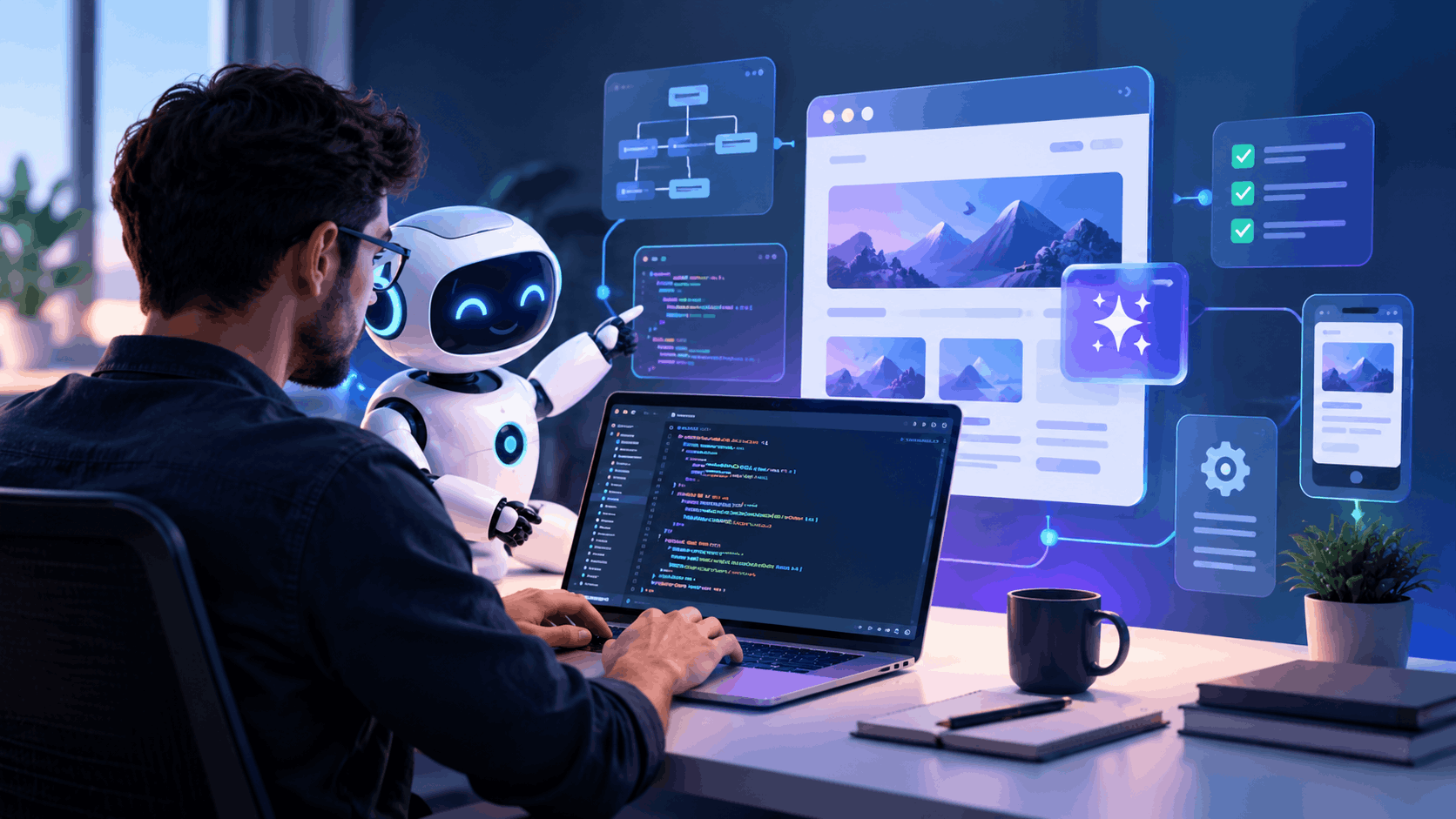
AI is transforming web development—from coding and testing to design, SEO, automation, and smarter user experiences. Discover how AI is changing the way modern websites are built.
Artificial intelligence is rapidly changing the way websites and web applications are designed, developed, tested, and maintained. What once required hours of manual coding and repetitive tasks can now be assisted by intelligent tools that understand code, generate solutions, identify problems, and help developers work more efficiently.
However, AI is not simply replacing traditional web development. Instead, it is becoming a powerful tool that works alongside developers, designers, and businesses to make the development process faster, more efficient, and more intelligent.
From AI-assisted coding and automated testing to personalized user experiences and intelligent web applications, the impact of artificial intelligence can already be seen across the web development industry.
How AI Is Changing Web Development
Traditionally, building a website involved a series of manual processes. Developers had to write code, search for solutions when errors occurred, test different implementations, optimize performance, and maintain the project over time.
AI-powered development tools are changing many of these processes. Developers can now describe a requirement in natural language and receive suggestions for HTML, CSS, JavaScript, Python, SQL, and other programming languages.
This does not mean that developers no longer need programming knowledge. Instead, developers can spend less time on repetitive tasks and more time thinking about architecture, user experience, business requirements, security, and creating better solutions.
1. AI-Assisted Coding
One of the most visible applications of AI in web development is AI-assisted programming. Modern AI coding tools can understand large portions of a project and assist developers while they write or modify code.
For example, a developer can describe a feature such as:
Create a responsive contact form with server-side validation and display a success message after submission.
An AI coding assistant can help generate the initial implementation and suggest the necessary HTML, CSS, JavaScript, backend logic, and validation rules.
AI can also help developers understand unfamiliar code, refactor repetitive functions, generate documentation, and identify potential bugs.
Common AI-assisted development tasks include:
- Generating code from natural-language descriptions
- Explaining existing code
- Finding and fixing programming errors
- Refactoring repetitive code
- Generating functions and components
- Creating database queries
- Writing documentation
- Generating unit tests
The result is often a faster development workflow, particularly for repetitive or well-defined tasks.
2. AI and Website Design
Artificial intelligence is also influencing the design stage of web development. Designers and developers can use AI to explore layouts, generate visual concepts, analyze user interfaces, and experiment with different design directions.
Instead of starting every design from a completely blank canvas, teams can use AI to quickly generate ideas and prototypes. These concepts can then be refined by human designers based on branding, accessibility, usability, and business requirements.
AI can also help analyze an existing interface and identify potential usability issues, such as unclear navigation, inconsistent spacing, poor content hierarchy, or weak calls to action.
Human design expertise remains important because a successful website is not only about visual appearance. It must also communicate the brand effectively and provide an intuitive experience for real users.
3. AI-Powered Content Creation
Content is another area where AI is having a significant impact. Businesses can use AI tools to assist with blog articles, product descriptions, website copy, FAQs, email campaigns, and other forms of digital content.
AI can be particularly useful during the research and drafting stages. It can help organize ideas, create outlines, rewrite content, and adapt existing information for different audiences.
However, automatically generated content should not simply be published without review. Human editing is essential for accuracy, originality, brand voice, factual correctness, and relevance.
The most effective approach is often a combination of AI assistance and human expertise: AI helps accelerate production while people provide the knowledge, context, creativity, and final judgment.
4. AI and SEO
Search engine optimization is also becoming increasingly connected with AI. Developers and content teams can use AI to analyze content, identify relevant topics, organize information, and improve the structure of web pages.
AI can assist with tasks such as:
- Generating content outlines
- Finding related topics and questions
- Improving headings and content structure
- Creating meta descriptions
- Analyzing existing website content
- Identifying content gaps
- Generating structured data suggestions
Nevertheless, SEO is not simply about generating large amounts of AI content. Search visibility depends on many factors, including content quality, relevance, technical performance, website structure, authority, and the usefulness of the information provided to visitors.
5. AI for Testing and Debugging
Testing is one of the most important parts of professional web development, but it can also be repetitive and time-consuming.
AI can help developers identify potential problems by analyzing code and suggesting test cases. It can also assist with debugging by examining error messages and identifying areas of code that may be responsible for a problem.
For example, if a web application produces an unexpected database error, an AI development assistant can help analyze the error message, inspect the related code, and suggest possible solutions.
AI can also help generate unit tests and edge-case scenarios that developers may want to consider before releasing a feature.
These capabilities can reduce the amount of time developers spend searching for simple programming mistakes and allow them to focus more heavily on complex application behavior.
6. AI and Web Application Security
Security is another important area where AI can assist development teams. AI-powered tools can help developers identify potentially vulnerable code, suspicious patterns, insecure configurations, and common security problems.
Developers can use AI assistance to review areas such as authentication, input validation, database queries, access control, and API interactions.
However, AI should not be treated as a replacement for professional security practices. Secure development still requires proper architecture, dependency management, access control, testing, monitoring, and regular security reviews.
7. AI and Python & Django Development
Python has become one of the most widely used programming languages for artificial intelligence and machine learning. This makes Python-based web frameworks such as Django particularly interesting for developers building AI-powered web applications.
Django can provide the foundation for a web application while AI services can be integrated to add intelligent functionality.
For example, a Django application could use AI to provide:
- Intelligent search
- AI-powered chat interfaces
- Automated customer support
- Content recommendations
- Document analysis
- Text classification
- Personalized user experiences
- Business process automation
This combination allows developers to build traditional web applications while adding intelligent features where they provide real value.
8. AI-Powered Personalization
Traditional websites often display the same experience to every visitor. AI makes it possible to create more personalized experiences based on user behavior, preferences, and interactions.
For example, an e-commerce website could recommend products based on previous interactions. A learning platform could recommend educational content based on a user's progress. A business website could provide different content depending on the visitor's interests or previous interactions.
Personalization can make websites more useful and engaging, but it should always be implemented responsibly. Businesses need to consider privacy, transparency, data protection, and user expectations when collecting and processing personal information.
9. AI and Website Automation
AI can also automate many repetitive processes that previously required manual work.
Consider a business website that receives customer inquiries every day. Instead of manually categorizing every request, an AI-powered system could classify incoming messages and route them to the appropriate department.
Similar automation can be used for tasks such as:
- Processing customer inquiries
- Organizing documents
- Summarizing large amounts of information
- Generating reports
- Classifying support requests
- Automating repetitive administrative workflows
- Extracting information from documents
The goal is not automation for its own sake. Good automation should reduce repetitive work while making the overall process more reliable and efficient.
10. Will AI Replace Web Developers?
One of the most common questions surrounding AI and web development is whether artificial intelligence will eventually replace developers.
AI can already generate impressive amounts of code, but building a professional web application involves much more than producing code.
Developers still need to understand business requirements, choose appropriate technologies, design application architecture, manage databases, consider security, optimize performance, test complex scenarios, and make decisions when requirements are unclear.
AI can generate a possible solution, but someone still needs to determine whether that solution is appropriate for the specific project.
As AI becomes more capable, the role of developers is likely to continue evolving. Instead of spending most of their time writing repetitive code, developers can increasingly focus on architecture, problem solving, product development, user experience, and integrating technology with business goals.
11. The Human Side of AI Development
Despite the rapid progress of artificial intelligence, human expertise remains essential in web development.
A website is ultimately created for people. Understanding users, businesses, industries, and real-world problems requires context that cannot always be captured by a simple prompt.
Developers and designers provide the judgment necessary to decide what should be built, why it should be built, and how it should work.
AI is therefore best viewed as a development partner rather than an independent replacement for the entire development process.
12. What the Future of Web Development Could Look Like
The future of web development will likely involve a closer relationship between humans and intelligent development tools.
Developers may increasingly describe business requirements in natural language and use AI systems to generate initial application structures, database models, interfaces, tests, and documentation.
At the same time, developers will continue to review, modify, test, secure, and optimize those systems.
We may also see websites become more adaptive and intelligent. Instead of simply displaying predefined pages, applications can respond to user needs, understand natural-language requests, automate complex workflows, and provide personalized experiences.
Conclusion
Artificial intelligence is changing web development at almost every stage of the process. From writing and debugging code to creating content, testing applications, improving user experiences, and automating business processes, AI is becoming an increasingly important part of modern development workflows.
But the real opportunity is not simply using AI to generate more code. The bigger opportunity is using AI to build better digital products, solve problems faster, automate repetitive work, and create experiences that are more useful to users.
For developers and businesses, learning how to work effectively with AI is becoming an important part of modern web development. The future will not necessarily be about AI versus developers. It will be about developers who know how to use AI effectively to build smarter, faster, and more capable websites.
At Arman Raya, we believe modern web development combines strong technical foundations with thoughtful design and emerging technologies. AI is another powerful tool that can help businesses create better digital experiences when it is applied with the right strategy.
- Tags:
- Custom Web Development
- Artificial Intelligence
- Ai Tools
- Future Of Technology
More Related Articles
Explore more insights on design, development, SEO, and digital products from the Arman Raya team.

How to Choose the Right Website Feature…
- 21 Sep 2026
- By Arman Raya
Website Maintenance: Why Launching Your…
- 30 Jun 2026
- By Arman Raya

How to Build Customer Trust on Your Web…
- 14 Jun 2026
- By Arman Raya

Why Doesn’t Your Website Generate Sales?
- 28 May 2026
- By Arman Raya

Comprehensive Guide to Designing Educat…
- 26 May 2026
- By Arman Raya

Lawyer Website Design with the Django F…
- 24 May 2026
- By Arman Raya
On-Page SEO vs. Off-Page SEO: What’s th…
- 21 May 2026
- By Arman Raya

Restaurant Website Design and Online Me…
- 20 May 2026
- By Arman Raya